Meet the Enzymes: Koji’s Secret Workforce
Think of enzymes as koji’s secret workforce: invisible, constantly working, and responsible for much of the sweetness, umami, and tenderness that make fermented foods so delicious.
The 60 Second Summary
Enzymes catalyse various chemical reactions occurring in living organisms. In koji fermentation, specific enzymes break down large molecules such as starch and protein into smaller compounds such as glucose and amino acids.
When Aspergillus oryzae grows on rice to make rice koji, it produces large quantities of enzymes. These break down starches and proteins into sugars, amino acids, and other beneficial compounds.
The two most important enzyme groups in koji are:
Amylases – break down starch into glucose and oligosaccharides, creating natural sweetness.
Proteases – break down proteins into amino acids and peptides, creating savoury umami flavour.
These enzymes continue working when koji is used to make miso, soy sauce, and sake.
For cooks, this is where the magic happens. Koji enzymes can:
– Increase natural sweetness
– Enhance umami
– Tenderise meat and fish
– Improve digestibility
– Create deeper, more complex flavours
In simple terms, the power of koji comes from its enzymes. They unlock flavours and textures that would otherwise remain hidden.
When people talk about the power of koji, what they are really talking about is the power of enzymes.
These microscopic workers are responsible for many of the transformations that make Japanese fermentation possible. Without them, there would be no sake, no miso, no soy sauce, and no amazake.
So what exactly are enzymes, and why are they so important?
From Rice to Rice Koji
Koji is produced by cultivating a mould called Aspergillus oryzae on grains such as rice, barley, or soybeans.
When Aspergillus oryzae grows on steamed rice, it becomes what we know as rice koji.
The process begins when tiny spores, known as conidia, are sprinkled over freshly steamed rice. After germinating, the mould begins to spread through the rice by extending fine thread-like structures called hyphae.
Like all living things, the mould needs food in order to grow. However, the nutrients contained in the rice are not immediately available.
To access them, the mould releases enzymes.
These enzymes break down the starches and proteins within the rice into smaller compounds such as glucose and amino acids. The mould then absorbs these nutrients and continues to grow.
After around two days, ordinary steamed rice has been transformed into rice koji.
What Makes Koji Different from Rice?
Rice koji contains many compounds that are not present in significant quantities in ordinary rice.
These include:
- Glucose
- Oligosaccharides
- Amino acids (including essential amino acids)
- Peptides
- B vitamins
- Organic acids
- Enzymes
The finished koji becomes covered in a fine white mycelium and develops a gentle sweetness alongside its distinctive chestnut-like aroma.
The same process can be applied to other grains and legumes.
- Rice + Aspergillus oryzae = Rice Koji
- Barley + Aspergillus oryzae = Barley Koji
- Soybeans + Aspergillus oryzae = Soybean Koji
Today, Aspergillus oryzae is responsible for producing most of the koji used in sake, miso, and soy sauce production, although Aspergillus sojae is also used in some soy sauce brewing.
So What Exactly Is an Enzyme?
Enzymes are specialised proteins that help chemical reactions happen more efficiently in living organisms.
A simple way to think about them is as microscopic tools. Each enzyme has a particular job. Some break down starch, others break down proteins, and others work on fats.
Like all proteins, enzymes are built from amino acids. Twenty different amino acids are used to build the proteins found in living organisms. Depending on how these amino acids are arranged and folded, they create proteins with different functions.
For example:
- Proteases break proteins into amino acids.
- Amylases break starch into sugars.
- Lipases break fats into fatty acids.
The enzymes produced by koji mould work in much the same way as the digestive enzymes found in the human body.
The Two Superstars of Koji
Although koji produces a wide variety of enzymes, two groups are especially important: proteases and amylases
Protease: The Umami Team
Protease is the collective name for enzymes that break down proteins.
However, protease is not just one enzyme. It is a team of enzymes working together.
The first group, known as proteinases, breaks large proteins into smaller fragments called peptides.
The second group, known as peptidases, continues the process by breaking those peptides down into individual amino acids.
Why does this matter?
Because amino acids are responsible for much of the rich savoury flavour we know as umami. By breaking down proteins step by step, proteases help create the deep flavour found in foods such as miso and soy sauce.
Amylase: The Sweetness Team
Amylase is the collective name for enzymes that break down starch.
Like protease, it is actually a family of enzymes rather than a single enzyme.
The first stage is carried out by α-amylase, which breaks large starch molecules into shorter chains of sugars.
Next, glucoamylase takes over, breaking these shorter chains down into individual glucose molecules.
This is the process that creates the natural sweetness found in products such as amazake.
Without amylase, the starch locked inside rice would remain unavailable. With it, that starch can be transformed into the sugars needed for fermentation and flavour development.
A Discovery That Changed the World
The enzymes produced by Aspergillus oryzae (koji mould) function in much the same way as the digestive enzymes found in our own bodies.
This remarkable connection was first discovered by the Japanese chemist Jokichi Takamine (1854–1922). In 1894, Takamine developed a digestive enzyme preparation known as Taka-diastase using enzymes derived from Aspergillus oryzae.
More than a century later, these enzyme preparations are still used in digestive medicines and are commonly taken to help relieve indigestion, overeating, or discomfort caused by excessive drinking.
How Koji Transformed Japanese Food
The real magic of koji lies in what its enzymes allow us to create.
Miso
When cooked soybeans are combined with rice koji or barley koji, the proteases in the koji break down soybean proteins into amino acids.
This process generates much of the deep savoury umami associated with miso.
Soy Sauce (Shoyu)
The same principle applies to soy sauce.
Koji enzymes break down plant proteins, releasing amino acids and helping create one of the world’s most complex and flavourful seasonings.
Thanks to koji, it became possible to unlock extraordinary amounts of flavour from plant-based ingredients.
Sake
Yeast cannot ferment starch directly.
Before fermentation can begin, the starch in rice must first be converted into glucose.
This process is known as saccharification, and it is the amylase in koji that makes it possible.
Without koji, traditional sake production would not exist.
Koji and Malt: Different Solutions to the Same Problem
In warm and humid Japan, sake brewing developed around koji — rice cultivated with beneficial mould — as a source of enzymes for saccharification.
In contrast, brewing traditions in cooler and drier regions such as the UK, relied on malted grains to provide the enzymes needed for beer production. Different climates and food cultures shaped different approaches, yet all served the same fundamental purpose: transforming starch into fermentable sugars.
Interestingly, there are now modern brewers experimenting with using koji in beer production, combining techniques from both traditions.
Takamine’s Unfinished Dream
More than a century ago, Jōkichi Takamine travelled to the United States with an ambitious idea.
He hoped to use koji instead of malt during whisky production.
Unfortunately, the project was never fully realised, partly because the factory involved was destroyed by fire.
Today, however, interest in koji is spreading rapidly beyond Japan.
As more people discover the remarkable power of its enzymes, Takamine’s vision of koji being used around the world may finally be coming true.
Endless Enzymes, Endless Possibilities
As Aspergillus oryzae grows, it continuously produces enzymes that break down proteins into amino acids and starches into sugars. These enzymes accumulate within the finished koji and become the driving force behind many of Japan’s most important fermented foods.
Once you understand what enzymes do, it becomes easier to understand why koji is so versatile.
The mould itself may be microscopic, but the workforce of enzymes it produces can transform starches into sugars, proteins into amino acids, and simple ingredients into some of the most complex flavours on earth.
The more we learn about koji and its enzymes, the more possibilities continue to emerge.
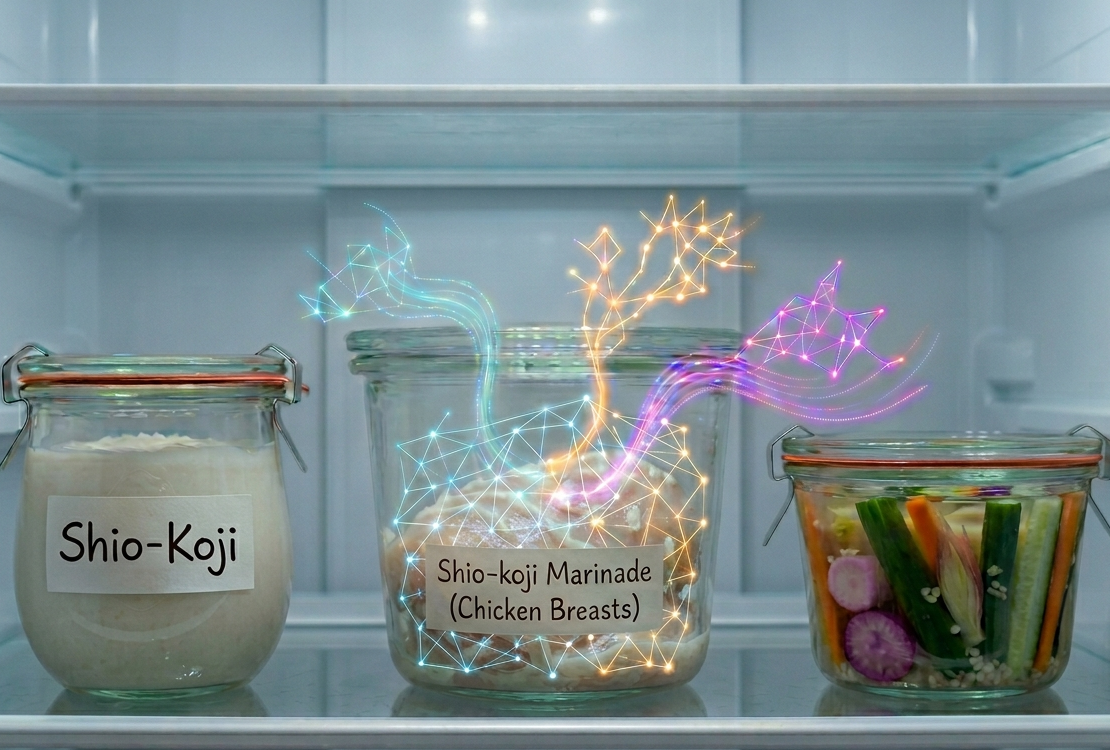
So the next time your guests bite into a piece of shio-koji-marinated chicken and marvel at how tender, juicy, and packed with umami it is, feel free to accept the compliments. Secretly, you’ll know that behind the scenes a tireless workforce of enzymes has been quietly breaking down proteins, unlocking flavour, and doing most of the hard work.
Sources & Further Reading
Books & Publications
Murakami, Hideya (ed.). Koji-gaku [The Science of Koji]. Tokyo: Brewing Society of Japan.
Koizumi, Takeo. Koji Kabi to Koji no Hanashi [A Look at Koji Mould and Koji]. Tokyo: Korin Publishing.
Koizumi, Takeo. E de Wakaru Koji no Himitsu [The Secrets of Koji, Explained Through Pictures]. Tokyo: Kodansha.
Fujimoto, Daizaburo. Kōso Hannō no Shikumi: Gendai Kagaku no Saidai no Nazo o Saguru [How Enzyme Reactions Work: Exploring One of Modern Chemistry’s Greatest Mysteries]. Tokyo: Kodansha.
Academic Papers
Narahara, H. (1994). “Koji-mold and its Product Koji (Part 1): Characteristics of Koji-mold.” Journal of the Brewing Society of Japan, 89(11), 873–881.
DOI: https://doi.org/10.6013/jbrewsocjapan1988.89.873
Historical & Online Resources
National Research Institute of Brewing. (2002). Special Feature: Koji Mold. NRIB: Newsletter of the National Research Institute of Brewing, No. 2, February 1, 2002.
https://www.nrib.go.jp/sake/nrib/pdf/NRIBNo02.pdf
National Research Institute of Brewing. (2003). Special Feature: Enzymes. NRIB: Newsletter of the National Research Institute of Brewing, No. 6, October 30, 2003.