
Aspergillus Oryzae: Miracle Mould
The Mould that Shaped a Nation
Over the course of some 1,000 years, during much of which the consumption of meat was restricted, a succession of alcoholic beverages and fermented condiments made using koji emerged in Japan. Sake, miso, soy sauce, vinegar, mirin, and amazake would all have tasted quite different had it not been for Aspergillus oryzae, known as koji-kin [麹菌] in Japanese.
Thanks to this “miracle mould,” Japan’s relatively limited range of ingredients was transformed into the exquisite tapestry of traditional Japanese cuisine. Washoku, as it is known, was inscribed on the UNESCO Intangible Cultural Heritage list in 2013, followed in 2024 by ‘Japan’s Traditional Brewing’, which celebrates the craft of utilising koji to produce sake and shochu.
A Matter of Nomenclature
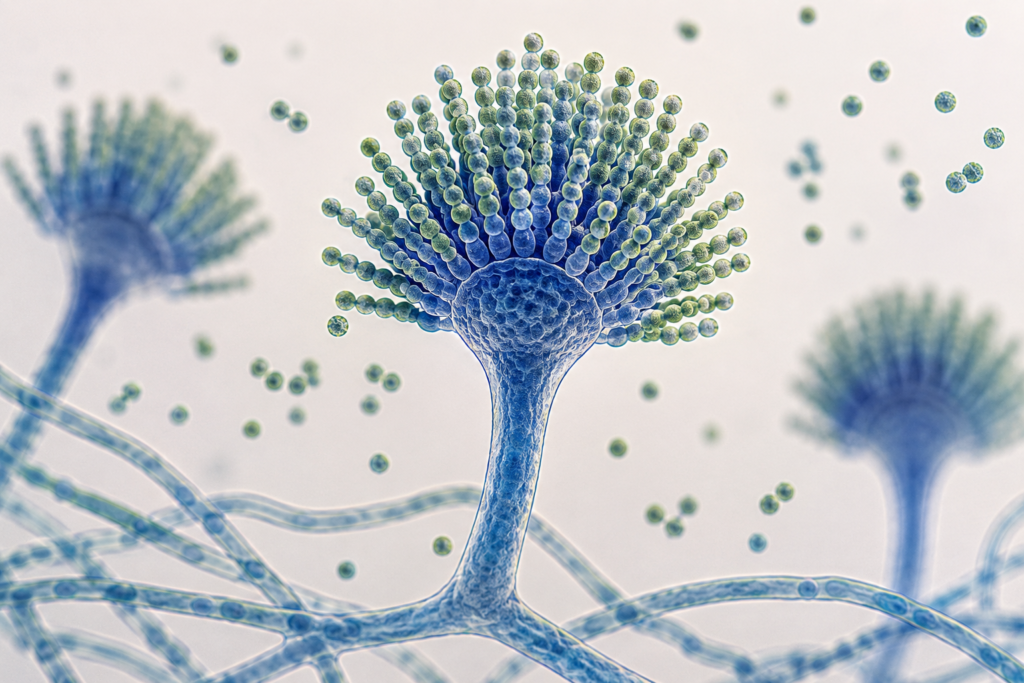
Aspergillus oryzae, cherished and nurtured with great dedication by the Japanese for centuries, takes its botanical name from the resemblance of its conidia-bearing structure to an aspergillum—the instrument used for sprinkling holy water. The species name oryzae derives from Oryza sativa, the scientific name for rice, as the fungus was originally isolated from the rice koji used in sake brewing.
In Japan, the terminology requires a little explanation:
Ki-koji-kin [黄麹菌]: Literally “yellow koji bacteria.”
Nihon-koji-kin [ニホンコウジカビ]: “Japan koji bacteria.”
Koji-kin [麹菌]: The most common term, meaning “koji bacteria.”
Orize [オリゼー]: Sometimes affectionately referred to by this transliterated shorthand.
Note: Although the literal translation of the word “kin” [菌] is bacteria, in the context of koji, it is more accurately described as a mould.
Hermann Ahlburg: A Short Life, A Lasting Discovery
The scientific discovery of Aspergillus oryzae came in 1876 via the German scholar Hermann Ahlburg while he was teaching botany and zoology at the Tokyo Medical School, the predecessor to the University of Tokyo’s Faculty of Medicine. He managed to isolate the fungus from koji used in sake brewing, and it is largely thanks to his research that we came to understand that microorganisms were responsible for the production of koji.
Ahlburg’s story is as tragic as it is significant. During a plant-collection outing in the scenic town of Nikko in 1878, he contracted dysentery and died at the young age of 28. The Japanese government, mourning the loss of such a brilliant pioneer, doubled his salary posthumously and sent it to his widow.
Tatsukichi Irisawa, the Dean of the Faculty of Medicine, later wrote movingly of Ahlburg’s final days in the countryside. He recounted how the dying scholar, desperate for an egg but unable to speak the local language, managed to communicate by flapping his arms like a chicken and forming the shape of an egg with his fingers. Years later, when Irisawa visited the birthplace of the poet Goethe in Frankfurt, a caretaker came out and asked whether he had known Ahlburg, whom he apparently described as a relative — an extraordinary coincidence.
Ahlburg was laid to rest in Yokohama, where he remains today. Other than that, very little information about him survives, which makes one wonder what kind of life he lived, what sort of person he was, and what became of the family he left behind in Germany. Though little is known of his private life, his discovery of Aspergillus oryzae remains a bright landmark in the history of Japanese brewing.
Clearing Koji’s Name
Most people tend to think of mould as something harmful or pathogenic. Indeed, Aspergillus oryzae is taxonomically related to Aspergillus flavus, a species infamous for producing the dangerous mycotoxin aflatoxin. The similarity in name, combined with a limited understanding of the differences between these closely related strains, apparently caused problems in the past when attempting to export Japanese-brewed products.
The catalyst for this concern was an incident in the United Kingdom in 1960, in which more than 100,000 turkey chicks died. The cause was said to be Aspergillus flavus proliferating in contaminated feed and producing aflatoxins. In the aftermath, it is not difficult to imagine that suspicion also fell upon Aspergillus oryzae because of its genetic similarity.
As a result, Aspergillus oryzae strains used in brewing were collected from across Japan, and researchers from industry, academia, and government joined forces to conduct extensive verification studies. Their findings demonstrated that the strains used in brewing do not produce aflatoxins, helping to dispel concerns surrounding them and reaffirming the safety of Japanese-brewed products.
In truth, the safety of Aspergillus oryzae had already been demonstrated through the long history of sake brewing itself. Nevertheless, genome analysis completed in 2005 provided further confirmation, revealing that the mould had lost the ability to produce mycotoxins at the genetic level.
Japan Crowns a National Hero
As you can see, the story of Aspergillus oryzae has taken many twists and turns, as well as weathering the occasional riot. It is a hard-working mould and, in skilled human hands, a remarkably cooperative one, producing the extraordinary substance known as koji, which enriches both the dining and drinking table. The culinary path travelled by the Japanese people is one they have walked side-by-side with Aspergillus oryzae.
Against this backdrop, and in recognition of its long-standing contributions as a precious national asset, the Japanese Society of Brewing Science designated Aspergillus oryzae as the “National Fungus” [国菌] in 2006.
Just as “Kimigayo” is the national anthem and the cherry blossom is its national flower, Aspergillus oryzae is recognised as Japan’s national fungus.
In addition, Aspergillus sojae, Aspergillus luchuensis — which produces the koji used in awamori and shochu — and Aspergillus kawachii have also been designated as national fungi.
Tiny Spores, Vast Possibilities
These koji moulds have long been described as a “treasure trove of enzymes” because of their remarkable ability to produce a wide variety of enzymes in large quantities. Beyond fermentation, these enzymes have found applications across numerous industries, including food production, pharmaceuticals, and detergents.
Although Aspergillus oryzae has been studied for many years, its lack of a sexual reproductive cycle, combined with the fact that its cells contain multiple nuclei, has made analysis using traditional genetic methods particularly difficult.
However, modern genomic analysis has allowed research at the genetic level to advance rapidly, probing deeper into the organism than ever before. The mysterious nature of Aspergillus oryzae and its vast, untapped potential are gradually being revealed through ongoing research.
Yet despite centuries of use, we humans may have only just begun to explore the microscopic universe hidden within this remarkable organism. From conidia measuring just 5 μm in diameter—far too small to be seen with the naked eye—extends a world of extraordinary complexity that we are only beginning to understand.
As our knowledge continues to grow, new possibilities for koji moulds are likely to emerge across an ever-wider range of fields and industries. The story of Aspergillus oryzae, it seems, is still only just beginning.
Sources & Further Reading
Books & Publications
Murakami Hideya (ed.), The Science of Koji (『麹学』), Brewing Society of Japan.
Kitamoto Katsuhiko, The Mystery of Japanese Cuisine and Umami: A Thousand-Year Tale Woven by the Native Koji Fungus, Orize (『和食とうま味のミステリー: 国産麹菌オリゼがつむぐ千年の物語』), Kawade Shobo Shinsha.
Nakajima Harushi, Japanese Traditions: The Science of Fermentation – The Secret of the “Umami” Created by Microorganisms (『日本の伝統 発酵の科学 微生物が生み出す「旨さ」の秘密』), Kodansha.
Academic Papers
Matsuyama M (1975), Tane-koji [Seed Koji] (『種麹』), Nippon Jozo Kyokai Zasshi (Journal of the Brewing Society of Japan), 70(10), pp. 705–709. View Article
Murakami H (1994), Herrman Ahlburg and his Surroundings: The Discoverer of Koji Mold (『ヘルマン・アールブルグとその周辺 —麹菌の発見者—』), Nippon Jozo Kyokai Shi (Journal of the Brewing Society of Japan), 89(11), pp. 889–896. View Article
Murakami H (1971), Discovery of Aspergillus oryzae: Independence of Koji Mold (『アスペルギルス・オリゼーの発見 —コウジカビの独立性—』), Nippon Jozo Kyokai Zasshi (Journal of the Brewing Society of Japan), 66(2), pp. 117–121. View Article
Scientific Conference of Brewing Society Japan (2006; partially revised 2013), Declaration on Koji Mold (『麹菌についての宣言』). View Article
Kitamoto K (2012), Koji-kin Monogatari [The Story of Koji Mold] (『麹菌物語』), Seibutsu-kogaku Kaishi, 90(7), pp. 408–411. View Article
Kitamoto K (2000), Recent Progress in Research on Koji Fungi (『麹菌研究の最近の進展』), Nippon Jozo Kyokai Shi (Journal of the Brewing Society of Japan), 95(6), pp. 404–411. View Article
Historical & Online Resources
Kikkoman Corporation, Soy Sauce: Explanation of the Koji Mold Genome (『しょうゆ:麹菌ゲノム解説』), Kikkoman Official Website.