
Umami: The Fifth Taste
The sacrosanctity of rice and the taboo of flesh remain two of the most important historical characteristics of Japanese food history. Against this cultural background, a strong food tradition centred on rice, fish, and vegetables developed across the archipelago. For well over a millennium—from the time Emperor Tenmu enacted the first ban on meat eating in 675 until Emperor Meiji declared its resumption in 1872—meat, dairy products, fats, and oils were not familiar foods to the Japanese people. Similarly, sugar was not easily available, meaning the Japanese diet lacked many of the elements that are ubiquitous in modern meals.
Despite the growing global population of vegetarians, vegans, and pescatarians, many people today find that the absence of meat, dairy, fats, or sugar can leave them feeling somewhat unsatisfied; these rich foods are simply too prevalent in our everyday diets. This raises an interesting question: what could possibly replace these heavy hitters to provide that same sense of satisfaction? Why were the Japanese perfectly happy to live for centuries on a diet consisting mainly of rice, vegetables, and fish?
The secret lies in umami, the so-called “fifth taste,” which the Japanese have recognised and nurtured for centuries before the word itself even existed. Looking back on the history of food, it may have been that umami alone made the restricted Japanese diet acceptable under those limited circumstances. Today, however, it has moved from a survival necessity to a completely indispensable and central element of Japanese cuisine.
The Signals of Survival
In addition to umami, the basic building blocks of taste—which cannot be created by mixing other flavours—are sweet, salty, sour, and bitter. These components send powerful signals to our taste buds to help us navigate our environment. Sweetness indicates a vital energy source, while saltiness signals essential minerality. Conversely, sourness warns us that food may be decomposing, and bitterness sounds a natural alarm to the presence of something potentially toxic.
It is the combination of these basic tastes that tells our brains if something is tasty and highly nutritious, or if it should be avoided at all costs. While modern gastronomy allows us to enjoy how sour and bitter notes contribute to overall deliciousness, in the age of the hunter-gatherer, distinguishing between these tastes was the difference between finding life-sustaining nutrition or something deadly poisonous.
From this perspective, umami can be viewed as a taste we are instinctively designed to crave. It acts as a signal that encourages us to ingest the proteins which are so vital for our growth, development, and the everyday functioning of the human body. As an indispensable building block of life, protein is a nutrient we naturally find delicious because it is quite literally what makes us who we are.
The Science of Savouriness
To understand umami further, we must touch on amino acids and nucleic acids. You don’t need to be a scientist to grasp this; simply think of them as the component parts of taste and flavour. Typical foods where umami is present contain glutamic acid, inosinic acid, and guanylic acid. Glutamic acid is a type of amino acid, whereas inosinic and guanylic acids are classified as nucleic acids.
Glutamate was discovered about 100 years ago by Professor Kikunae Ikeda as a key component of umami. However, it wasn’t until the discovery of the “umami receptor” on the tongue in the 2000s that the taste became recognised globally. There was initially much scepticism regarding whether umami truly existed as a distinct taste, but since the discovery of this receptor, it has gained worldwide attention.
We can see the relationship between these components and our food clearly:
Glutamate is found in both animal and plant-based foods.
Inosinic acid is contained primarily in meat and fish.
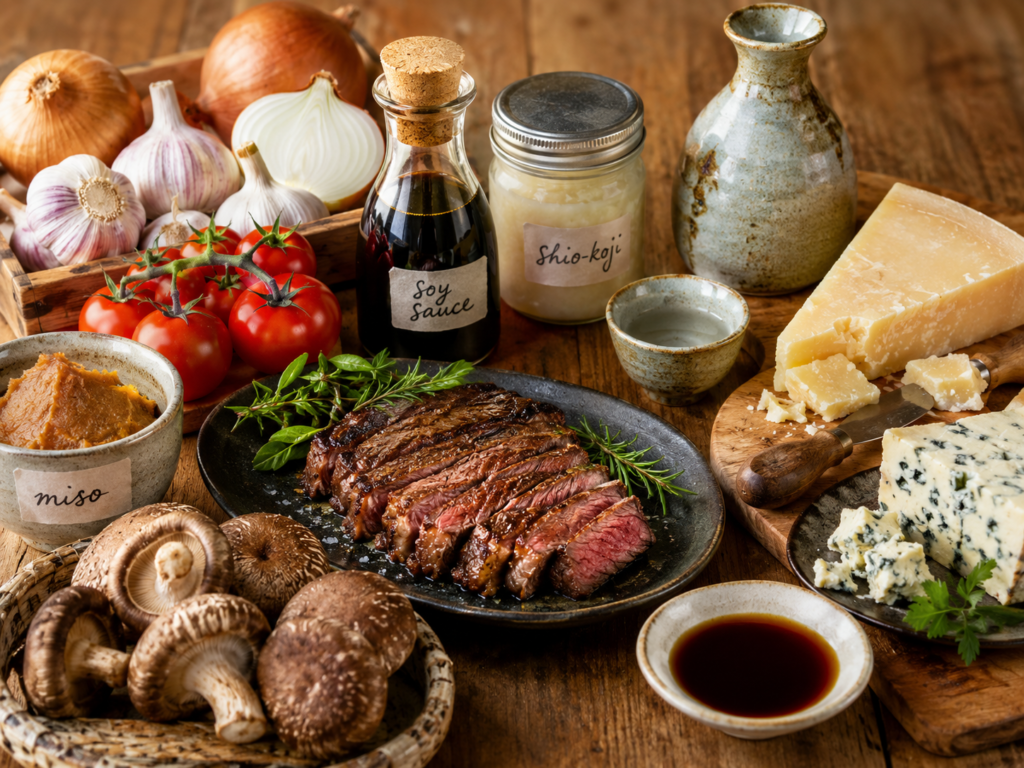
Guanylic acid is found in dried shiitake, dried tomatoes etc.
Notably, all of these umami components were discovered by Japanese researchers.
The Power of Synergy
Perhaps the most important culinary aspect of umami is its synergistic effect. This means the sensation of umami is felt far more strongly when amino acids and nucleic acids are combined than when those components are tasted alone.
This synergy is the “secret sauce” behind global culinary staples. Japanese dashi stock combines kombu (glutamic acid) and dried bonito flakes (inosinic acid) to create a massive flavour profile. You see the same principle in a classic French bouillon, a stock made from stewing meat and vegetables, or a traditional Chinese täng soup. All these examples demonstrate how extracting and combining these acids enhances the umami experience—a discovery that we also owe to the work of Japanese scientists.
The Koji Connection
This deep understanding of umami is exactly what makes koji the heart of Japanese culinary tradition. While the discovery of the “umami receptor” is a modern milestone, the use of Aspergillus oryzae (koji mould) has been the practical method for “unlocking” these flavours for centuries. Koji acts as a natural catalyst; its enzymes break down the proteins in grains, beans, and meats into the very amino acids—specifically glutamate—that our bodies are evolutionarily primed to seek out. By mastering shio-koji and other fermentations, you aren’t just seasoning your food; you are participating in an ancient tradition of maximising nutrition and satisfaction.
Sources & Further Reading
Books & Publications
Fushiki Tohru, The Mystery of Dashi (『だしの神秘』), Asahi Shinsho.
Fushiki Tohru, The Secret of Umami (『うま味の秘密』), Shibunkaku Publishing.
Kitamoto Katsuhiko, The Mystery of Japanese Cuisine and Umami: A Thousand-Year Tale Woven by the Native Koji Fungus, Orize (『和食とうま味のミステリー: 国産麹菌オリゼがつむぐ千年の物語』), Kawade Shobo Shinsha.
Nakajima Harushi, Japanese Traditions: The Science of Fermentation – The Secret of the “Umami” Created by Microorganisms (『日本の伝統 発酵の科学 微生物が生み出す「旨さ」の秘密』), Kodansha.
Academic Papers
Torii K (1995), Development of Taste Sensation and its Nutritional and Physiological Roles: Taste and Preference (『味覚の形成とその栄養生理学的役割 —味覚と嗜好性との関係—』), Kouinka (The Japanese Journal of Stomato-pharyngology), 7(3), pp. 245–254. View Article
Historical & Online Resources
Non-Profit Organization Umami Information Center.
Umami Information Center
Japan Umami Seasoning Association.
Japan Umami Seasoning Association