
How to Survive a Thousand Years Without Meat
1,000 years of imperial meat bans, a landscape of natural disasters, and a beer called Juice Rocket. We look at how Japan mastered the art of koji to flourish in the meatless millennium.
Confession: Juice Rocket has nothing at all to do with koji!
It is, in fact, a fantastic craft beer we used to enjoy in a great little pub near our former home in the UK. One thing that struck me during the four years we spent living in Cambridgeshire was the profound difference in the food and drink culture between the UK and Japan—something which you feel strongly when visiting the nation’s pubs.
While the pub in question—The Drayman’s Son—lacks a formal kitchen, their cheese, ham, and pickle rolls and generous mixed platters provide a delicious accompaniment as the beer “rockets” into the taste buds. It is hardly haute cuisine, but it just works. When my husband was busy brewing sake, we rarely had the opportunity to visit, so our trips there were always a special pleasure.
Conversely, a good Japanese izakaya offers a deep sense of seasonality through its changing menu of fish, vegetables, and sake. Summer is all about fresh, fruity, unpasteurized nama sakes, which you might enjoy with a succulent, deep-fried horse mackerel, aji-furai. Autumn is a time to enjoy the fabulous hiya-oroshi sake, paired with a delicious grilled sanma (Pacific saury). Winter and spring, too, provide their own delights both on the plate and in the glass.
The different climates and customs that shape our respective food cultures are reflected in these pubs and izakayas; it is in these spaces that we truly experience the “taste of a nation.” While staples like sushi, ramen, and katsu curry are now global favourites, many are surprised to learn that Japanese cuisine is largely underpinned by the miracle of koji mould. It was this tiny microorganism that provided the key to flourishing through a millennium without meat.
Nature’s Influence, Good and Bad
Japan is an island nation frequently beset by earthquakes, tsunamis, and typhoons. This constant environmental pressure has arguably forged a unique social resilience—a collective understanding that maintaining harmony is a necessity for survival.
The natural world also richly colours the dinner table with seasonal bounty from the sea and mountains, fostering a deep reverence expressed through the elegant simplicity of Japanese cuisine. Furthermore, Japan’s humid climate has enabled a great artistry in fermentation. Staples like miso, soy sauce, rice vinegar, mirin and sake all rely on the power of koji microorganisms, which provide the foundational wealth of flavour in the Japanese diet.
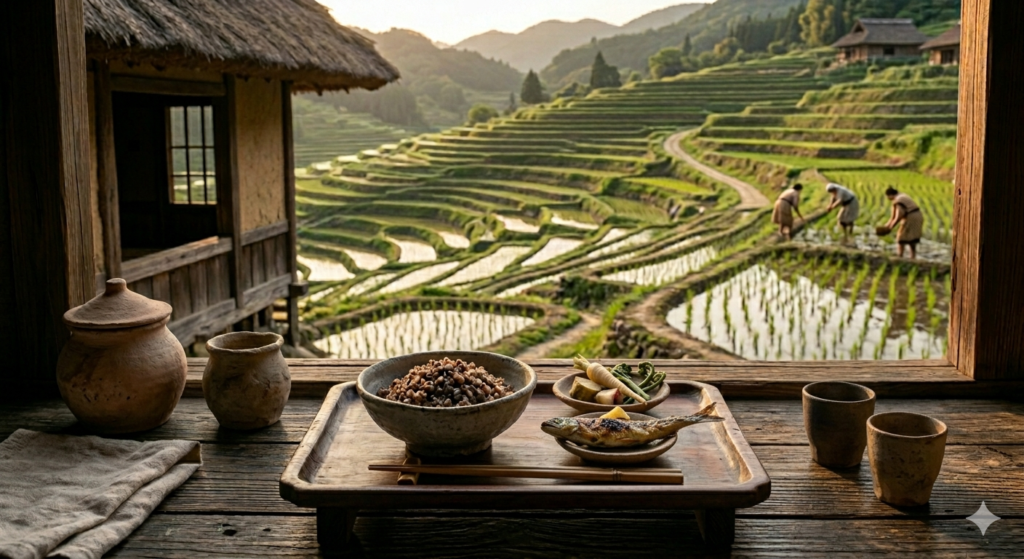
This warm, humid weather also provided perfect conditions for wet rice cultivation, triggering a shift from hunter-gathering to agriculture as early as the 10th century BC. While early farming communities still bred pigs and chickens for protein, the foundations for a rice-led economy—and the eventually dominant role of koji—were being laid.
The Prohibition of Flesh
It is difficult to imagine in modern Japan, but the spread of Buddhist and Shinto faiths, once transformed meat-eating into a widely shunned taboo. In 675 AD, Emperor Tenmu issued the first of several bans on meat consumption, notably limited to the farming season from April to September. While unique food cultures were taking shape in Hokkaido and Okinawa—where rice cultivation had yet to flourish—the rest of the archipelago began to turn away from animal protein. Abstaining from meat during this time likely served as a collective prayer for a safe and bountiful rice harvest, as the government looked to cement a religious and economic shift.
Buddhism, introduced in the mid-6th century, brought doctrines against killing that naturally removed meat from the diet. Simultaneously, Japan’s indigenous Shinto religion viewed the spilling of blood as a spiritual impurity (kegare). These concepts likely predated organised religion; the 3rd-century Records of the Wa People in the Chronicle of Wei, notes that the Japanese abstained from meat for more than ten days while mourning the dead. It appears that even before the official spread of religion or imperial decrees, the Japanese had their own unique views on death, killing, and the consumption of meat.
Rice as the National Pillar
As meat became taboo, rice emerged as the nation’s staple, prized for its flavour and ability to be stored long after harvest. By the late 7th century, the government promoted cultivation to secure tax revenue, effectively turning rice into the pillar of the national economy. Because natural disasters often threatened these vital harvests, the population increasingly looked heavenward in prayer, adhering to the Emperor’s meat ban to ensure divine favour for the fields.
However, the transition was far from easy. Many farmers struggled to sustain themselves through farming alone and continued to hunt, while even the elite often indulged in meat in private. Despite this resistance, repeated government decrees and top-down religious pressure eventually took hold. Over the centuries, the taboo filtered down from the aristocracy to become the standard for the common people, cementing a culture that looked to the land and sea, rather than livestock, for sustenance.
A Geography for Fish, Not Cattle
Beyond religious constraints, Japan’s geography played a decisive role. It is clear that livestock farming—which requires vast grazing lands and the management of large herds—was unsuitable for Japan, both geographically and climatically, given that much of the country is covered by rugged mountains and forests, and that settlements and rice paddies were being developed in the limited lowland and wetland areas. Consequently, fish became Japan’s staple protein, supported by the incredible wealth of the surrounding seas. Even today, Japan remains one of the largest importers of meat in the world.
The Umami Factor
While geography and religion may have closed the door on meat for over a millennium, they effectively opened a window to a new world of flavour: umami. This shift necessitated a mastery of the sea and soil, leading the Japanese to turn to the microbial power of koji. By using koji to unlock umami’s deep savouriness from simple grains and beans, Japan created a sophisticated and healthy culinary tradition that doesn’t rely heavily on meat—one so significant it has been inscribed by UNESCO as an Intangible Cultural Heritage of Humanity.
For the Meat & Fish Lover: Discover how koji’s enzymes tenderise proteins, enhance umami and intensify the natural flavours of your favourite cuts. [Explore our full Recipe Collection →]
For the Plant-Based Explorer: Whether you are flexitarian, vegan, or somewhere in between, use koji to bridge the “satisfaction gap” and bring incredible savoury depth to plant proteins. [Try our Meat-Free Koji Recipes →]
Sources & Further Reading
Books & Publications
Ishige Naomichi, A History of Japanese Food Culture: From the Palaeolithic Age to the Present Day (『日本の食文化史 ー 旧石器時代から現代まで』), Iwanami Shoten.
Harada Nobuo, Rice and Meat in History: Food, the Emperor and Discrimination (『歴史のなかの米と肉 食物と天皇・差別』), Heibonsha.
Harada Nobuo, The History of Japanese Cuisine: Japanese Cuisine Culture Booklet No. 5 (『和食の歴史 和食文化ブックレット⑤』), Shibunkaku Publishing.
Kitamoto Katsuhiko, The Mystery of Japanese Cuisine and Umami: A Thousand-Year Tale Woven by the Native Koji Fungus, Orize (『和食とうま味のミステリー: 国産麹菌オリゼがつむぐ千年の物語』), Kawade Shobo Shinsha.
Nakajima Harushi, Japanese Traditions: The Science of Fermentation – The Secret of the “Umami” Created by Microorganisms (『日本の伝統 発酵の科学 微生物が生み出す「旨さ」の秘密』), Kodansha.