
High MACs, Fermented Foods, and Umami
How High MAC foods, fermentation, and umami support the gut microbiota and overall health.
Among the many fermented foods now attracting attention for their relationship to gut health, traditional Japanese koji-based foods occupy a particularly fascinating position. Miso, shio-koji, shoyu-koji, amazake, and soy sauce are not only rich in flavour, but also products of a fermentation culture refined over centuries.
Embracing fermentation and fermented foods is increasingly recognised as an effective way to support wellbeing through improved gut health. Let’s explore the secret behind the ideal symbiosis between our gut bacteria and our overall health.
When we think of fermentation, we tend to picture foods such as pickles, sauerkraut, yoghurt, cheese and sourdough bread, but fermentation also happens in our own bodies, carried out by gut bacteria in our intestines.
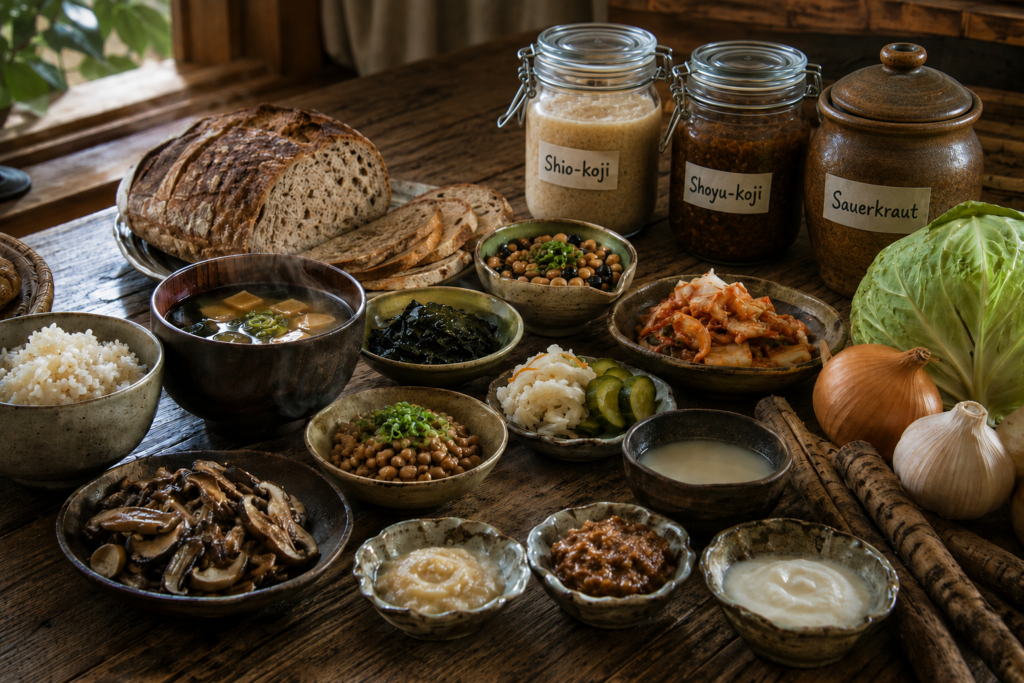
MACs and Gut Bacterial Fermentation
Dietary fibre and oligosaccharides, known as prebiotics, are considered important nutrients for beneficial gut bacteria. Because they cannot be broken down by human digestive enzymes, they pass through the stomach and small intestine intact before reaching the large intestine, where they serve as food for the microorganisms living there.
Beneficial gut bacteria—such as Bifidobacteria, Lactobacilli, and butyrate-producing bacteria—use these prebiotic compounds as a nutrient source, fermenting them to produce a range of metabolites, including short-chain fatty acids, which are thought to contribute to health and the maintenance of a healthy gut environment.
As our understanding of the health benefits associated with gut bacterial fermentation has grown, increasing attention has focused on “fermentable dietary fibre“—indigestible carbohydrates that reach the large intestine and are broken down by gut microbes. In the West, these are often referred to as MACs (Microbiota-Accessible Carbohydrates) and are increasingly recognised as playing an important role in maintaining health.
Foods rich in MACs are often referred to as High MAC foods. These include soluble dietary fibre, resistant starch, and resistant oligosaccharides. By providing this kind of “feast” for our gut bacteria, we help create an environment in which they can thrive and support our overall health.
However, non-fermentable dietary fibre also plays an important role in helping to remove waste and undesirable substances from the digestive tract, so it remains important to consume a balanced variety of fibre-rich foods.
Fermented Foods and Microbial Diversity
Another important element not to be overlooked is fermented foods. Plant-based fermented foods, in particular, can be thought of as “super gut-activating” foods because they combine the benefits of synbiotics and postbiotics.
These foods contain live or inactivated microorganisms, along with beneficial metabolites produced during fermentation, including lactic acid, amino acids, vitamins, and enzymes.
Research suggests that fermented foods may be just as important as dietary fibre in maintaining a healthy gut flora.
What the Research Suggests
In 2021, a study conducted by Hannah C. Wastyk and colleagues at Stanford University examined the effects of dietary fibre and fermented foods on the gut microbiota.
Thirty-six adults were divided into two groups: one followed a diet rich in dietary fibre, while the other consumed a diet rich in fermented foods. Changes in the gut microbiota were observed after both groups had continued the diet for 10 weeks.
The results showed that, although the high-fibre group displayed little change in microbial diversity, the group consuming fermented foods exhibited a noticeable increase in the richness and variety of their gut microbiota.
Looking at these findings, it is easy to understand why fermented foods are regularly consumed in regions around the world associated with longevity and good health.
As the beneficial microorganisms found in fermented foods do not permanently colonise the gut, it is advisable to incorporate fermented foods into the daily diet in a balanced and consistent way.
The Role of Umami
And there is one more important thing not to forget: umami.
One of the great strengths of koji fermentation is its ability to naturally generate deep umami without relying heavily on fats, sugar, or excessive seasoning. This may be one reason why traditional Japanese cuisine was historically able to remain satisfying despite being comparatively low in animal fats and dairy products. Both miso and soy sauce, which are made using koji, are rich in umami developed through fermentation.
Why not incorporate miso and soy sauce into your cooking and savour their deep, complex flavours? Shio-koji and shoyu-koji can also be used to bring out the natural umami of your ingredients. By doing so, you may find it surprisingly easy to enjoy satisfying meals whilst reducing your intake of fats and sugar.
Furthermore, excessive consumption of animal fats, sugar, and salt is said to negatively affect the balance of gut bacteria. By incorporating umami skilfully into the daily diet, it may be possible to help support a healthier intestinal environment.
Dysbiosis and the Modern Diet
So, let us consider what causes the balance of the gut flora to become disrupted, leading to a state of dysbiosis?
Harmful bacteria feed primarily on proteins. Under normal conditions, they do not usually cause problems. However, if they proliferate excessively, they are said to produce putrefactive compounds such as amines, hydrogen sulphide, ammonia, indole, and skatole, as well as certain carcinogenic substances.
Normally, protein is digested and absorbed in the stomach and small intestine. However, it is said that excessive consumption of a high-fat, high-protein diet—particularly one centred on meat—can result in undigested residues reaching the large intestine.
When harmful bacteria feed on these substances and begin to proliferate excessively, they can become dominant within the gut, contributing to constipation and the production of putrefactive compounds that may disrupt the balance of the gut flora. This imbalance can lead to skin problems, while toxins produced in the intestines may pass into the bloodstream and place strain on organs such as the liver, heart, and kidneys.
Towards a Healthier Symbiosis
When planning our future diets, we must consider not only portion sizes and calorie counts, but also the impact food has on our gut flora.
This is not a concern limited to adults. Future food education should not only teach nutritional balance and knowledge about food, but also encourage an understanding of the gut microbiota and its relationship to our health.
Improving children’s dietary habits and nurturing a healthy gut flora may benefit not only physical health but also mental well-being, helping to foster motivation, emotional balance, and a positive outlook.
It is said that the balance of the gut flora can be disrupted by factors such as antibiotic use, poor dietary habits, stress, and smoking. Furthermore, the diversity of the gut microbiota is believed to decline with age.
Nurture beneficial gut bacteria with High MACs, support the diversity of your gut flora with fermented foods, and embrace umami to reduce the need for excessive seasoning.
This is not merely a health regimen, but a new way of eating — one that enhances quality of life by beginning within the gut.
High MACs, Fermented foods, and Umami.
The synergistic effects of these three different forms of fermentation will likely be key to building a healthy symbiotic relationship between us and our gut bacteria.
Traditional Japanese fermentation cultures centred on koji may therefore offer valuable insights into the future of healthy eating. Through the combined power of High MAC foods, fermented foods, and umami, they present a dietary approach that nourishes both the gut microbiota and the human body in a deeply sustainable way.
To extend our healthy lifespan, we should also maintain balanced daily rhythms, engage in moderate exercise, and ensure sufficient sleep. By caring for ourselves each day, we can connect the present to a healthier future.
Sources & Further Reading
Books & Publications
Naito Yuji, The Science of Gut Microbiota: Building the Foundation of Health (『健康の土台をつくる 腸内細菌の科学』), Nikkei BP (2024).
Mitsuoka Tomotari, Training the Gut: Gut Microbiota and Intestinal Flora (『腸を鍛える――腸内細菌と腸内フローラ』), Shodensha (2015).
Fushiki Tohru, The Mystery of Dashi (『だしの神秘』), Asahi Shinsho.
Fushiki Tohru, The Secret of Umami (『うま味の秘密』), Shibunkaku Publishing.
Kitamoto Katsuhiko, The Mystery of Washoku and Umami: A Thousand-Year Story Woven by Aspergillus oryzae (『和食とうま味のミステリー―国産麹菌オリゼがつむぐ千年の物語』), Kawade Shobo Shinsha.
Nakajima Harushi, The Science of Fermentation in Japanese Tradition: The Secret of Umami Created by Microorganisms (『日本の伝統 発酵の科学―微生物が生み出す「旨さ」の秘密』), Kodansha.
Academic Papers
Yamamoto Y, Hamajima H, Tanaka Y, Fujimaru Y, Sakamoto M, Miyagawa S, Nishimukai M, Yanagita T, Nakamura T, Mitsutake S, Nagao K & Kitagaki H (2019), Health Benefits of Glycosylceramides Contained in Koji (『麹に含まれるグリコシルセラミドの健康効果』), Seibutsu-kogaku Kaishi, 97(4), pp. 182–185. View Article
Kato N & Akasaka N (2019), Functionality of Fermented Foods and Related Fields: Preface to the Special Issue (『発酵食品の機能性と関連領域:特集によせて』), Seibutsu-kogaku Kaishi, 97(4), p. 173. View Article
Kitagaki H (2020), Global Cultural Value of Japanese Fermented Foods (『日本の発酵食品が有する世界的な文化価値』), Ad Studies, 74, pp. 32–35. View Article
Wastyk HC, Fragiadakis GK, Perelman D, Dahan D, Merrill BD, Yu FB, Topf M, Gonzalez CG, Van Treuren W, Han S, Robinson JL, Elias JE, Sonnenburg ED, Gardner CD & Sonnenburg JL (2021), Gut-Microbiota-Targeted Diets Modulate Human Immune Status, Cell, 184(16), pp. 4137–4153. View Article
Miyaki T, Imada T, Hao SS & Kimura E (2016), Monosodium L-Glutamate in Soup Reduces Subsequent Energy Intake from High-Fat Savoury Food in Overweight and Obese Women, British Journal of Nutrition, 115(1), pp. 176–184. View Article
Uneyama T (2015), Physiological Role of Umami Taste Substance, Monosodium Glutamate in Healthier Life (『うま味物質の健康価値:グルタミン酸ナトリウムの生理機能』), Kagaku to Seibutsu, 53(7), pp. 432–441. View Article
Sasano T (2010), On the Importance of Umami Taste Sensation (『「うま味」感覚の重要性について』), Shika Gakuho, 110(6), pp. 794–799. View Article
Historical & Online Resources
Naito Yuji (2025), The Importance of the Intestinal Environment for Healthy Longevity, Minna no Hakko BLEND. View Article
Fermentable Dietary Fiber Promotion Project, A Wellbeing Lifestyle Starts in the Gut: Building Healthy Habits with Fermentable Dietary Fibre. View Article