
The Potential of Shio-koji
A Seasoning That Transforms Food
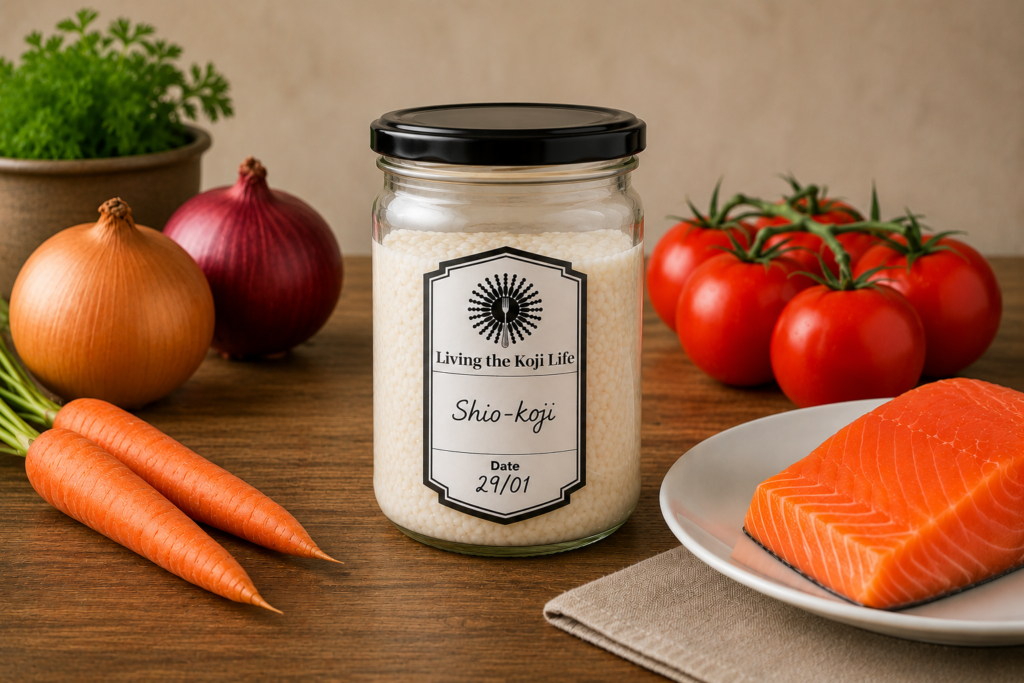
There are many handmade seasonings made from rice koji, but shio-koji is the simplest of them all; it brings out the natural flavours of ingredients and can be used in a wide variety of dishes.
Shio-koji is more than just a seasoning; it penetrates ingredients as a marinade, bringing out their umami whilst transforming the very texture of the food. It also gently ferments vegetables, adding depth to their flavour.
Rather than simply cooking, these transformations feel more like little experiments. There is a quiet thrill in watching flavours deepen and ingredients transform over time.
For someone like me, who didn’t originally have a strong interest in cooking, it was precisely this series of small discoveries that taught me that it can be joyful.
I’d like to share a few thoughts on the surprises and delights I’ve experienced with shio-koji, as well as the benefits it offers.
The Pickle Experiment: Unlocking the Depth of Vegetables
In Japan, where I was born and raised, there is a large range of fermented foods readily available. Tsukemono or pickled vegetables are indispensable as a side dish to complement rice. However, if rice is not a daily staple food in their diet, some people can find the tsukemono a little salty.
While I was living in England and started making shio-koji, I would use it to make asazuke, which means lightly pickled vegetables, in the hope that they would be more to my husband’s liking.
They are incredibly simple to make; simply cut whatever vegetables you like in whatever style you fancy and marinate in shio-koji for a half day or overnight. Adjust to your taste by using shio-koji at a ratio of between 5-10% the weight of the veggies. I also mixed things up from time to time by adding a little yoghurt or a 50:50 blend of yoghurt and miso. All variations are tasty and keep for a decent amount of time in the fridge, so you always have something convenient to hand as a snack or quick salad.
However, something felt slightly lacking, and I found myself wondering every day if there wasn’t a way to ferment vegetables so that they tasted even better. During my research, I got to know a little about sauerkraut and Korean nabak kimchi, otherwise known as water kimchi. Using these as inspiration, I decided to experiment by changing the salt used in sauerkraut to shio-koji and also added some water similar to the kimchi. With nabak kimchi, rice water is used, but as shio-koji contains a lot of nutrients to start with, I decided to use regular water.
I remember being impressed by how much better the pickles tasted. The nutrients from the rice koji create an ideal environment for lactic acid bacteria. The acidity produced during fermentation, combined with the umami and sweetness of the shio-koji and vegetables themselves, gave the pickles a much richer flavour than simple salt pickling alone.
Synbiotics, Postbiotics, and Fermented Vegetables
Besides tasting great, these koji-fermented vegetables contain beneficial oligosaccharides and dietary fibre, and they also improve the overall microbial diversity of our digestive tract. We can think of this as synbiotics. This is the simultaneous intake of probiotics and prebiotics. This combination is said to help improve the balance of the intestinal flora more effectively than taking them alone.
If all this wasn’t enough reason to get munching, these koji-fermented vegetables contain a mixture of beneficial metabolites for humans, including dead fermentation microorganisms, enzymes, amino acids, glucose, lactic acid and various vitamins. This also appears to apply to postbiotics.
In this way, fermenting vegetables using salted koji adds flavours and nutritional value not found in the original ingredients, improves shelf life, and transforms them into foods that are even more beneficial for us.
Protein, Enzymes, and Tenderness
Shio-koji appeared on the culinary scene in Japan in the early 2010s. It is a rich and flavourful condiment that combines a salty taste with the umami and sweetness derived from rice koji. But that is not all. Shio-koji is also rich in enzymes derived from rice koji.
When combined with protein ingredients such as meat and fish, the multitude of enzymes contained in shio-koji produce the following results:
- Umami is drawn out from the ingredients themselves.
- Shita-aji: Shio-koji’s enzymes impart a vital sense of base flavour.
- Easier Digestion: Nutrients are more easily digested and absorbed.
- Tenderisation: Proteins become tenderised as enzymes break them down.
- Rapid Ageing: Maturation can be achieved in a fraction of the time.
These benefits attracted considerable attention, and this revolutionary fermented condiment brought a fresh wave of interest to the Japanese culinary world. Many housewives noted that even inexpensive cuts of supermarket meat tasted like high-quality meat when marinated in shio-koji.
Unlike my largely meat-averse husband, I must confess to being a bit of a carnivore. A treat for me is to go out to a yaki-niku restaurant where you grill the meat yourself at the table. I have to drag him kicking and screaming, as it really isn’t his thing, and they rarely have a decent sake selection. As I get older, though, I’m finding that eating a lot of meat can make me feel sluggish. During the following days, I feel like my face is slightly swollen, my skin is not so bright, and my makeup doesn’t seem to go on so well. My concentration also seems to suffer, and occasionally I become irritable. I can see why my husband dreads my craving for yaki-niku!
I believe this state is the result of digestion and absorption being unable to keep up with the amount of meat consumed, allowing harmful bacteria to become dominant in the gut. When the balance of our intestinal flora is disturbed, the effects can extend far beyond simple indigestion. Indigestion can be caused by overeating, but it is also said to be triggered by overwork, stress, and simply getting older. As the years go by, I’m sure many people find they can no longer face a big, voluminous steak in the way they used to.
Managing Dysbiosis
To prevent the gut flora from tipping into a state of dysbiosis, it is vital to avoid this kind of indigestion. The good news for protein lovers, though, is that the enzymes in shio-koji can alleviate these problems. When meat is marinated in shio-koji, the protease enzymes break down the proteins and allow for a certain amount of pre-digestion. This makes the meat tender and reduces the burden on digestion and absorption. The breakdown of proteins also increases the amino acid content, which in turn delivers umami.
The same applies not only to meat, but also to fish and other protein-rich foods. Japanese supermarkets and department stores are full of various meats and fish marinated in shio-koji, soy sauce koji, koji miso, etc.
The Transformative Power of Shio-koji
Shio-koji is a remarkably versatile fermented seasoning that is both delicious and beneficial to our health. It enhances umami and depth of flavour whilst increasing nutritional value and improving shelf life. By aiding digestion and nutrient absorption, it also helps make everyday meals gentler on the body and more satisfying to eat. In this way, shio-koji is far more than a seasoning; it is a traditional fermentation culture that quietly transforms the way we experience food.
Keep your koji larder stocked ..
If you choose just one addition to your kitchen, let it be shio-koji. It couldn’t be simpler to make and you can use it in dozens of ways. It really is the gateway drug to your journey into koji-based condiments. Go to our koji Essentials section to see how it is made.
Sources & Further Reading
Books & Publications
Yamamoto Masahiro, Koji no Chikara! (The Power of Koji!), Fuunsha (2012).
Academic Papers
Maehashi Kenji, Oto Arika, Yamamoto Tatsuhiko, Asari Taeho and Kashiwagi Yutaka (2015), Effect of Aging Temperature on Residual Enzyme Activity in Salt-Koji Production, Journal of the Japanese Society for Food Science and Technology, 62(6), pp. 290–296.
https://www.jstage.jst.go.jp/article/nskkk/62/6/62_290/_pdf
Enguchi Noriko, Yukawa Natsuko and Nakanishi Yoko (2016), Caseinolytic Activity of Homemade Shio-koji, Journal of Cookery Science of Japan, 49(2), pp. 166–171.
https://www.jstage.jst.go.jp/article/cookeryscience/49/2/49_166/_pdf
Maehashi Kenji (2016), Characteristics of a New Brewed Seasoning “Shio-koji”, Journal of the Brewing Society of Japan, 111(2), pp. 71–77.
https://www.jstage.jst.go.jp/article/jbrewsocjapan/111/2/111_71/_pdf/-char/en
Abe Maki and Akita Osamu (2019), Effects of Koji-Derived Enzymes and Salt in Shio-koji on Meat Cooking, Journal of the Brewing Society of Japan, 114(5), pp. 258–266.
https://www.jstage.jst.go.jp/article/jbrewsocjapan/114/5/114_258/_pdf/-char/ja
Maehashi, K. (2017), Flavoring Characteristics of Shio-koji (『塩麹の調味特性』), Bulletin of the Society of Sea Water Science, Japan, 71(4), pp. 232–239.
https://www.jstage.jst.go.jp/article/swsj/71/4/71_232/_pdf
Historical & Online Resources
n/a