
Koji’s Riotous Past
It’s hard to believe that such a benevolent mould could incite civil unrest, but in 1444, the ancient capital of Kyoto played host to the Bun-an Koji Incident, a riot by any other name.
A Profitable Mould
Unthinkable today in the context of sake brewing, but originally, brewers did not make their own koji. Instead, they had to rely on specialised manufacturers called koji-ya [麹屋], who produced and sold it to breweries, keeping the knowledge and immense skill required to make good koji as closely guarded secrets. Breweries, of course, could not survive without koji, so it was seen as a product with a guaranteed profit potential.
Guilds and Monopolies
Consequently, the koji-za [麹座] was established in the early 13th century. A za was a kind of trade guild governed by those in power, such as court nobles or the authorities of shrines and temples. It is said that, under the protection of the shogunate, the koji-za held a monopoly on the manufacture and sale of koji and permitted only guild-affiliated merchants to trade. Within the koji-za, the Kitano Guild, organised by the shrine attendants (shinjin) of Kitano Tenmangu in Kyoto, held particular influence.
Brewers in Defiance
As mentioned earlier, sake brewers at that time were not permitted to produce koji themselves and were obliged to purchase it exclusively from the koji-za. Before long, however, brewers began to resist, citing the high cost of koji and the belief that they could produce better sake by making it themselves. Eventually, some brewers openly rebelled against the monopoly and began producing their own koji, which the koji-za could simply not allow.
As a result, breweries soon discovered that producing their own koji without permission prompted visits from the soldiers of the shogunate, who arrived to destroy their muro, the specialised rooms in which koji was cultivated. This only inflamed tensions further, leading the monks of Enryaku-ji Temple, who had close ties to the brewers, to join in the demands for the abolition of the koji-za.
Kyoto Erupts!
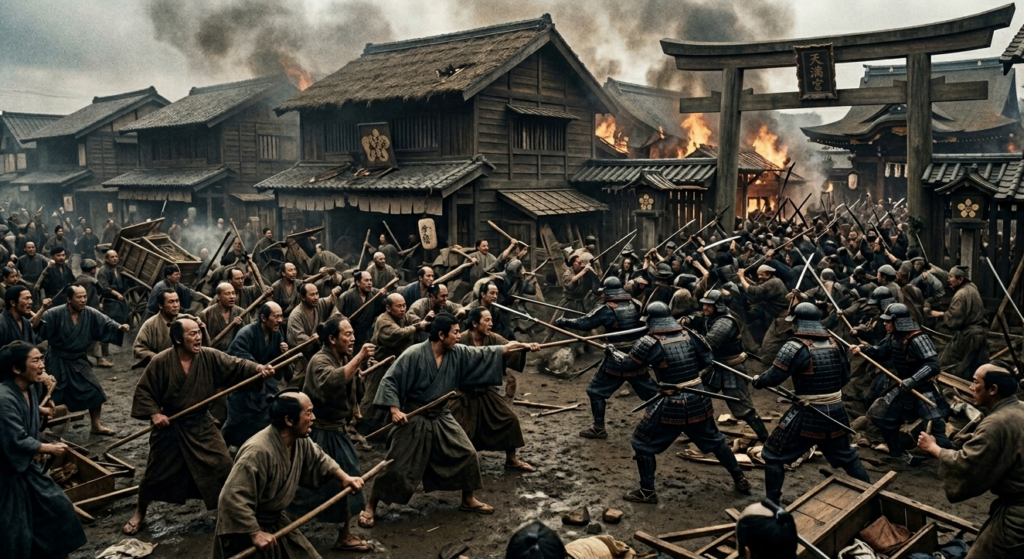
In response to the growing unrest, the Muromachi Shogunate indicated a willingness to relax the strict koji-za system, a move naturally opposed by the shrine attendants of Kitano koji-za. In protest, they barricaded themselves inside the shrine, escalating the dispute with the shogunate into a full-blown armed conflict which saw much of the shrine burned to the ground.
These events later became known as the Bun-an Koji Incident of 1444 and ultimately led to the collapse of the koji-za itself, paving the way for breweries to begin making their own koji in the manner they still do today. Although the koji-za monopoly was reinstated the following year, the shogunate had already lost much of its authority in the matter, and the system gradually faded away.
Mould for Peace
Long before microorganisms were scientifically understood, medieval Japanese society had already become economically and culturally dependent upon them.
It is somewhat humbling to think that, in the midst of all this fighting, the microorganisms themselves were quietly and obediently continuing to make koji. Next time you find yourself meditatively mixing koji by hand, give thanks that you are not being attacked by katana-wielding samurai.
Sources & Further Reading
Books & Publications
Murakami Hideya (ed.), The Science of Koji (『麹学』), Brewing Society of Japan.
Kitamoto Katsuhiko, The Mystery of Japanese Cuisine and Umami: A Thousand-Year Tale Woven by the Native Koji Fungus, Orize (『和食とうま味のミステリー: 国産麹菌オリゼがつむぐ千年の物語』), Kawade Shobo Shinsha.
Nakajima Harushi, Japanese Traditions: The Science of Fermentation – The Secret of the “Umami” Created by Microorganisms (『日本の伝統 発酵の科学 微生物が生み出す「旨さ」の秘密』), Kodansha.
Koizumi Takeo, A Look at Koji Mould and Koji (『麹カビと麹の話』), Korin Publishing. Koizumi Takeo, The Secrets of Koji, Explained Through Pictures (『絵でわかる麹のひみつ』), Kodansha.
Ishikawa Masayuki, Moyashimon, Vol. 5 (『もやしもん 5』), Kodansha.
Academic Papers
Murai Saburō (1968), Past and Present Tales of Koji Mould (『麹カビの今昔物語り』), Chemistry and Biology, 6(1), pp. 31–36. View Article
Matsuura Shinji (1964), On the Effects of Ash in Tane-Koji (『タネこうじ灰の効用について』), Journal of the Brewing Society of Japan, 59(11), pp. 938–944. View Article
Marukawa Yoshihiro (2014), The Archaeological Remains of Earthen Storehouses and Sake Breweries (『土倉と酒屋の遺跡』), 252nd Kyoto City Archaeological Museum Cultural Heritage Lecture Series: “Archaeological Sites and Kyoto in the Sengoku Period” (Part 2), Kyoto City Archaeological Research Institute. View Article